

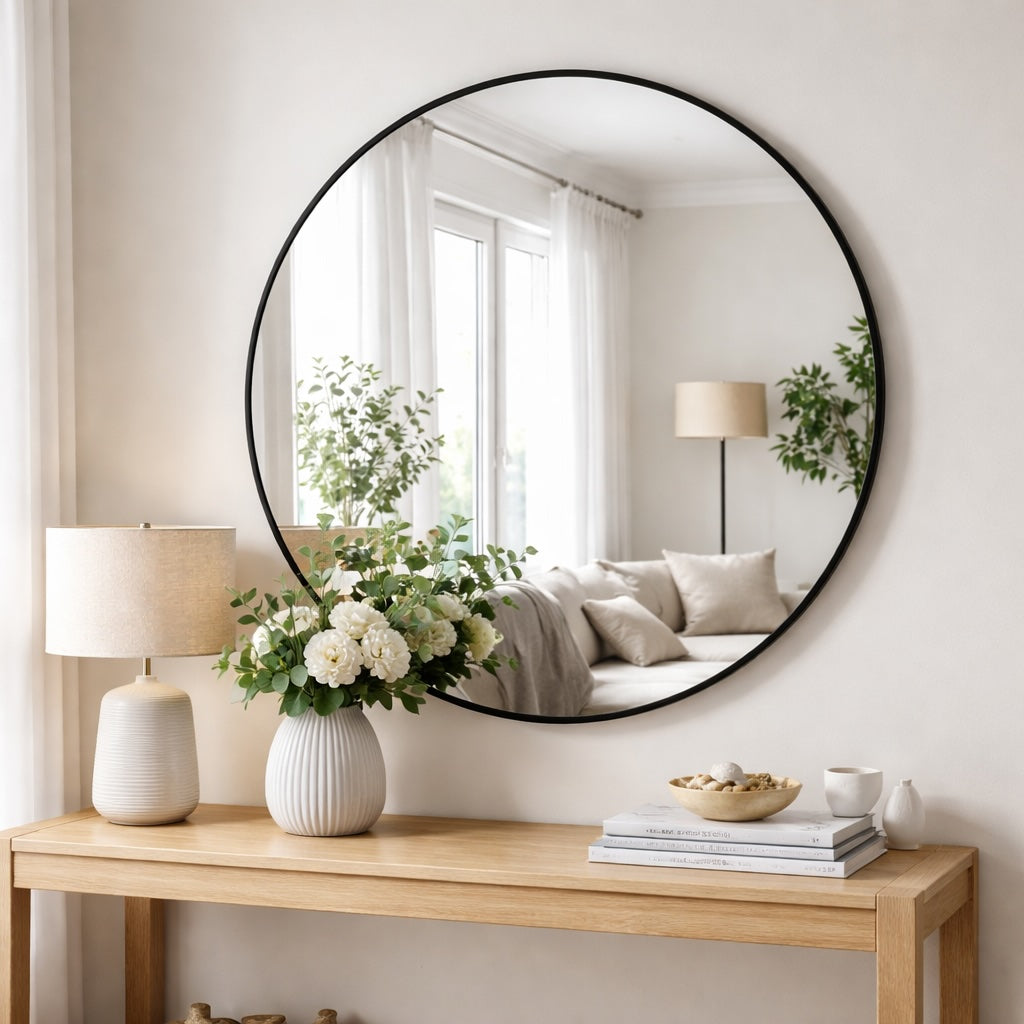
Circular mirrors are one of the simplest ways to make a home feel brighter, bigger, and more refined. If you’re choosing your first round mirror (or finally upgrading to a statement size), the Rei range makes it easy: modern black and warm gold finishes, with sizes from 50cm right through to an impressive 180cm.
Explore the full range here: Jobu Circle Mirrors Collection.
Part One: Why a Circular Mirror Belongs in Your Home
The rise of the round mirror in modern interiors
Interior design has moved away from harsh angles and rigid layouts. The most desirable spaces now feel balanced: structured but soft, minimal but warm, and clean without feeling clinical. A circular mirror fits perfectly into this shift.
Where rectangles bring sharp definition, a round mirror introduces flow. It breaks up straight lines, softens corners, and creates a focal point without making the wall feel heavy. It’s the kind of upgrade that makes a room feel “finished” — like it belongs in a design magazine.
If you want maximum impact, oversized options like the Rei 180cm in black create an architectural feature while reflecting light across the entire space.
Choosing the right size: from subtle accent to statement feature
The Rei range runs from 50cm to 180cm, which means you can use a circular mirror as a subtle styling lift or a true statement wall feature. The “right” size is the one that looks intentional in your room — not like an afterthought.
- 50cm–70cm: Perfect for cloakrooms, vanity areas, compact bedrooms, and smaller wall sections. A great example is the Rei 50cm in gold.
- 80cm–100cm: A sweet spot for hallways, guest bedrooms, and above-console styling. Try the Rei 90cm in black.
- 120cm–180cm: Best for large feature walls, open-plan living, luxury bedrooms and home gyms. The Rei 120cm in gold is a standout “statement but still versatile” option.
Featured Statement Piece: Rei 180cm Gold Circular Mirror

The Rei 180cm gold round mirror is made for open-plan living spaces, oversized feature walls, and high-end interiors where scale matters. The warm gold frame adds instant luxury while the huge reflection boosts light and depth across the room.
- Designed for open-plan living and feature walls
- Extra-large 180cm diameter
- Warm gold metal frame for a premium finish
- Professionally tested hanging points (installed with suitable load-rated fixings)
Black or gold? Styling your frame colour
Black framed circular mirrors
A black frame gives a crisp outline and architectural strength — ideal for Scandinavian, industrial, minimalist, monochrome, or modern-rustic spaces. It pairs beautifully with pale walls, oak or walnut furniture, and concrete textures.
Gold framed circular mirrors
Gold brings warmth and understated luxury. It’s especially effective with neutral palettes, soft greys, layered lighting, stone finishes, and boutique hotel–style bedrooms. The result feels elevated, not flashy.
Best Seller: Rei 120cm Gold Round Mirror

The Rei 120cm gold circular mirror is the perfect “go-to” statement size — big enough to anchor a wall, yet balanced enough for hallways, bedrooms, and dressing areas. If you want impact without overwhelming the room, this is the one.
- Balanced 120cm diameter
- Ideal for bedrooms, hallways and dressing areas
- Warm gold metal finish
- Easy to style with modern neutral interiors
Where to position a circular mirror for maximum impact
- Hallway above a console: Reflects light, adds depth, and creates a welcoming entrance.
- Bedroom dressing zone: Above drawers or a dressing table for a refined, luxury feel.
- Living room feature wall: Above a sofa, fireplace or sideboard to soften large blank walls.
- Home gym / wellness space: Functional for training while keeping the room calm and premium.
- Bathroom / en-suite: Spa-inspired styling with matching black or gold hardware.
If you’re still deciding, start with the Circle Mirrors Collection and choose by room first, size second.
Why a Rei circular mirror will improve your space
- Enhances natural and artificial light
- Makes rooms feel larger and more open
- Adds an architectural focal point without clutter
- Improves daily functionality (dressing, checks, workouts)
- Creates a premium, curated look
Part Two: How to Measure, Position, and Hang Your Circular Mirror Correctly
Installing a large circular mirror correctly is essential for both safety and appearance. The steps below help you measure accurately, position the mirror exactly where you want it, and select appropriate fixings for your specific wall type.
Tools and equipment you will need
Before you start, gather the right tools. This makes installation cleaner, safer, and far more accurate.
- Spirit level (or laser level) – to align the mirror visually
- Tape measure – for positioning and bracket spacing
- Pencil – for marking drilling points
- Drill – with suitable bits for your wall type (masonry / wood / drywall)
- Screwdriver or drill driver – to secure screws firmly
- Wall fixings and screws – chosen for your wall type and load rating
- Stud finder (recommended) – helps detect studs, pipes, and cables
- Step ladder (if needed) – safe access at height
- Vacuum cleaner / dust catcher – to reduce mess while drilling
- Protective gloves (recommended) – safer handling for large mirrors
For mirrors over 100cm, use at least two people for lifting, positioning, and hanging.
Pro tip: Put a soft blanket or cardboard on the floor beneath your work area. It protects both the mirror and your flooring and gives you a safe resting surface while measuring and positioning.
1) Decide exactly where your mirror will sit
Start by deciding the final position of the mirror. Think about alignment with furniture, lighting, and room symmetry.
- In most rooms, the mirror looks best with the centre at around 150cm–160cm from the floor
- Above furniture, leave roughly 15cm–25cm between the top of furniture and the bottom of the mirror
- Stand back and check it looks centred with the console/drawers/sofa below
- Check reflections: you want the mirror reflecting light and space — not clutter
Pro tip: Make a simple template (paper/cardboard) or mark a circle outline with masking tape. This helps you visualise the size and placement before drilling.
2) Understand the relationship between your “final mirror position” and the fixing points
This is the key step people miss: you don’t mark the wall from where you think the mirror will go — you mark it based on where you want the mirror to finish, and where the rear brackets sit relative to the mirror edges.
With the mirror safely supported (on a blanket), measure:
- The horizontal distance between brackets (if more than one bracket)
- The vertical distance from the top edge of the mirror down to each bracket
- How many fixing points your mirror uses (1–3, depending on size)
Now you can translate your desired “top edge” or “centre point” position into exact wall marks for the screws. Using a spirit level, transfer those measurements onto the wall precisely.
3) Allowing for hand-welded frame tolerances
Rei mirrors are hand welded and hand finished. This premium, handcrafted construction can sometimes mean very minor tolerances in frame or bracket alignment compared to mass-produced items.
In practical terms, the rear fixing points may not always sit in perfectly symmetrical positions. This is normal for hand-finished metal frames and does not affect the mirror’s safety when installed correctly.
- Prioritise how the mirror looks visually on the wall (what your eye sees)
- Use the spirit level on the frame, not only on bracket measurements
- Fine-tune screw depth slightly if needed to achieve the best visual level
- If it looks level to the eye, it is correctly installed — even if measurements aren’t perfectly identical
4) Mark and prepare your drilling points
Mark your drilling points lightly in pencil. Use a spirit level to ensure the marks are aligned.
Pro tip: Put masking tape over the drill point before drilling. It helps reduce chipping, prevents the drill bit wandering, and makes dust easier to wipe away.
- Double-check the bracket spacing against your marks
- Confirm height and centring one more time
- Use a stud finder (recommended) to reduce risk of drilling into hidden pipes/cables
5) Selecting the correct wall fixings (critical step)
Fixings are not supplied because every home has different wall types. You must choose fixings that are: (1) suitable for your wall construction and (2) load-rated for the mirror’s weight.
- Brick / Concrete (solid wall): heavy-duty wall plugs and high-load screws
- Plasterboard / Drywall: heavy-duty cavity anchors, toggle bolts, Grip-It style fixings
- Stud walls: fix directly into studs where possible (best), or use heavy-duty cavity fixings
If you are unsure, consult a qualified installer or a specialist fixings supplier. Using incorrect fixings can lead to instability or failure.
6) Calculating load capacity for your fixings
To select suitable load-rated fixings, you can calculate the minimum load each fixing point must support:
Mirror weight ÷ number of brackets/fixing points = minimum load per fixing point
Example: If your mirror weighs 36kg and uses 3 fixing points, each point must support at least 12kg.
Your chosen fixings must be rated to carry more than this value, and ideally with a generous safety margin. (In other words: don’t aim for “exactly enough” — choose fixings comfortably above the requirement.)
7) Installing fixings into a solid wall (brick or concrete)
If your wall is brick or concrete, this is the general method:
- Drill holes using a masonry bit sized for your chosen wall plugs
- Drill to the correct depth for the plug
- Remove dust from the hole (vacuum/blower helps)
- Insert wall plugs flush with the surface
- Screw in the screws, leaving the correct protrusion for the rear brackets to hook onto
Pro tip for less mess: Hold a vacuum nozzle just beneath the drill point while drilling, or tape a folded paper “tray” under the hole to catch dust.
8) Hanging and aligning the mirror
Lift the mirror into position with assistance and carefully locate the brackets onto the screws.
- Use at least two people for large mirrors
- Lower the mirror gently so brackets fully engage
- Check stability before letting go
- Use a spirit level to assess the frame
9) Leaner-style installation
If using your mirror as a leaner, it must still be secured to the wall to prevent tipping or sliding. Always use suitable restraints and load-rated fixings. A professional installer can advise on the safest method.
10) Final safety checks
- Confirm the mirror sits flush and stable
- Check for any movement
- Do not add additional weight to the mirror or brackets
- Keep children from climbing or pulling on the mirror
- Periodically re-check fixings for long-term security
- If you are unsure of any of these steps please consult a professional installer
Frequently Asked Questions About Circular Mirrors
How high should a round mirror be hung?
As a general guide, the centre of the mirror looks best at around 150cm–160cm from the floor. Above furniture, leave approximately 15cm–25cm between the mirror and the surface below.
Are round mirrors better than rectangular mirrors?
Round mirrors soften sharp lines and create a calmer visual balance, which is why they suit modern interiors so well. Rectangular mirrors can feel more structured and traditional — it depends on the look you want.
Can I hang a large round mirror on plasterboard?
Yes, but only with heavy-duty cavity fixings rated for the mirror’s weight. For mirrors over 100cm, professional installation is strongly recommended to ensure safe load distribution.
Do gold mirrors go out of fashion?
A quality gold finish is timeless when styled with neutral palettes and warm lighting. Softer gold tones work across trends and complement both modern and classic interiors.
Is a large circular mirror worth it?
A larger mirror reflects more light, adds depth, and creates a stronger focal point. If you want a high-impact upgrade, a statement-sized round mirror is one of the best investments you can make.
How many fixing points do Rei mirrors use?
Depending on size, Rei circular mirrors use between one and three professionally tested hanging points. Choose fixings that are suitable for your wall type and load-rated for the mirror’s weight.
Want to browse sizes and finishes? Shop Rei Circle Mirrors.
,%20the%20Rei...)